Overview
Our Standard GL Integration includes a basic set of mappings that will serve the needs of most customers.
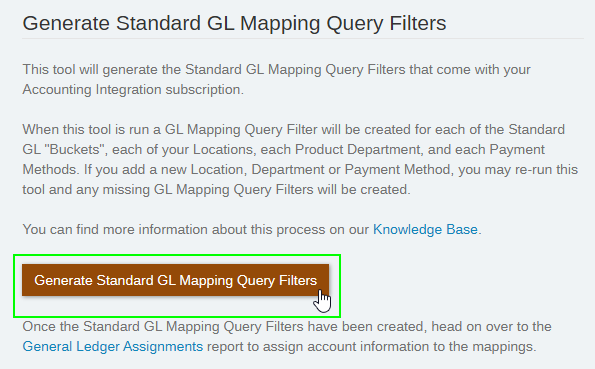
This article will step through generating the Standard GL Integration mappings which will create a GL Mapping Query Filter in each of the Standard GL "Buckets" defined for Cloud Retailer for each one of your Locations, Departments and Payment Methods. It will also cover how to configure the GL assignments.
Creating General Ledger Accounts
You must generate new GL mapping query filters any time after a new department or payment method is created to ensure the accounting reports will balance.First, the Generate Standard GL Mapping Query Filters tool will automatically create the following accounts for each store location:
- Cost
- Deposits Received
- Deposits Tendered
- Inventory Sales (as a whole not by department)
- Return Totals
- Sales By Department
- Sales By No Department
- Tender Closing Totals (by tender type)
- Tender Opening Totals (by tender type)
- Tender Over Totals (by tender type)
- Tender Short Totals (by tender type)
- Tax Totals
- COGS (as a whole not by department)
- Not Contributing To Sales
- Sales Rounding Error
Procedure
- Log into your back office
- Navigate to Reports > Generate Standard GL Mapping Query Filters
- Click the Generate Standard GL Mapping Query Filters button
- When the process is complete, click the Done button in the pop-up window
Assigning General Ledger Accounts
Now that the GL assignments have been created, they must be mapped to appear in our accounting reports. Here is a breakdown of the report columns.
- Location: Displays the location for the GL assignment
- Name: This identifies the Cloud Retailer account. Clicking the Name link offers additional filtering options. See Advanced Filtering Options below
- Description: This identifies that account type and suggests a GL type
- GL description: This is what you will see in your accounting software description or note field
- GL code: This will typically match the GL Description
- GL Type: This tells the system if this account is Debit/Credit
The next 2 are only accessible by clicking on the name and editing the fields at the bottom of the query filter. These are only necessary if you are using our Quickbooks Online integration.- QuickBooks Online Account Name: This must match the Name of the GL assignment under Chart of Accounts in QuickBooks Online. As you begin to type, a dropdown will appear with a list of all Chart of Accounts that match the input data. Simply click on the appropriate Chart of Accounts when it appears in the list
- QuickBooks Online Account Description: This is the line item description you will see in QuickBooks Online. Typically this will be the same as the GL Description column.
For best results, we recommend you fill out every GL assignment. This will ensure all data points are mapped to an appropriate account.- Log into your back office
- Navigate to Reports > General Ledger Assignments
- Enter a GL Description, GL Code, and GL Type for each assignment
- (Optional) Review or modify the data filters: This is only necessary if you'd like to be very specific in the data captured for each assignment.
- Click on the Name of the GL assignment to open the Edit Query Filter screen
- Update the Advance Filtering to capture the appropriate data. This is designed to be identical to reports and allows you to truly customize this feature for advanced configurations.
- Save the form after any changes are made
- Repeat for each assignment as necessary
Depending on how your accounts are balanced, there may more than GL assignment linked to the same account in your Quickbooks.Example

References
Was this article helpful?
That’s Great!
Thank you for your feedback
Sorry! We couldn't be helpful
Thank you for your feedback
Feedback sent
We appreciate your effort and will try to fix the article